If you’re going to be at San-Diego Comic-Con this coming weekend, please visit the Abrams booth (#1216) and check out the preview Galleys of Hereville! These aren’t as cool as the real book will be — they’re in black and white, not color, and they’re not hardcover, and some of the cool designy elements of the actual book are replaced by quotes and the like. But it’s still really cool — it’s a full-size, bound, 144 page graphic novel. And the art actually looks really good in gray-scale.
Even better, for Comic-Con Kids’ Day on Sunday, Abrams will be giving away copies of the Hereville galley for free! Can’t beat that deal.
Plus, check out the Abrams booth for a big pile of non-Hereville coolness: Jason Shiga will both be signing his amazing graphic novel Meanwhile, and they’ll be giving away a bunch of other free goodies, including Diary of a Wimpy Kid swag and a Jamie Hernandez poster. (Man, I wish I could go this year, if only so I could snag one of those Hernandez posters!). You can read more about the Abrams booth offerings here.
On July 20, 2010 · Comments Off on Aaron Diaz’s Thoughts on Cartooning
Aaron Diaz, the wonderful cartoonist behind Dresden Codak, has a new blog where he shares his thoughts on cartooning, with a strong focus on craft. Check it out.
On July 19, 2010 · Comments Off on Help Rachel Fix Her Wonky Mouth: Bid On A Sketchbook of Crows And Teeth!
Cartoonist Rachel Nabors needs jaw surgery (ouch!). To help pay for this (the surgery alone costs $18,500, not including the hospital charges), a sketchbook that I and many other cartoonists contributed to is being auctioned on ebay this week.
The cartoonists in the book include Bryan Lee O’Mailley, Raina Telgemeier, Andy Runton, Hope Larson, Jenn Lee, Dylan Meconis, Jake Richmond (who also colored the Hereville graphic novel), Brendan Douglas Jones, Derek Kirk Kim, Bill Mudron, Steve Lieber, and many more.
Here’s what I sketched in the book:

You can also contribute directly to Rachel’s medical fund — a “donate” button can be found here.
[My awesome friend Rachel Edidin tweeted that she had “Just sent someone a huge long list of comics recommendations for her 11-year-old daughter.” Of course, I immediately asked her if I could post the list here. Thanks, Rachel!
Also, I added links. Where Rachel recommended a series of books I linked to the first in the series. Or just to a random choice, if the series didn’t have any apparent order. –Barry]
The following is a list I compiled casually–mostly off the top of my head, which is my excuse for many of the no doubt numerous omissions (Sock Monkey! How could I have forgotten Sock Monkey?!)–for an acquaintance who asked me to recommend comics for her eleven-year-old daughter. As I mention below, I wasn’t shooting for a comprehensive list, nor even a super thorough one: the titles I mentioned are, for the most part, ones that I’ve read and enjoyed and that I feel comfortable recommending with little or no reservation to an eleven-year-old (and her parents). The list is also tailored somewhat to the interests of this particular eleven-year-old, who likes adventure and space but isn’t particularly interested in fairies, romance, or soap-opera angst.
In short: Your mileage will vary.
The other major considerations that went into the list were accessibility–I wanted to include books she was likely to be able to find at her school or local public library–and content–no explicit sex or graphic violence, and a hashmark to indicate books I thought Mom might want to review before passing them along to her daughter (not just based on sex and violence–for example, I marked Tintin because I’d balk at giving it to a kid without a conversation or two about racism and colonialism; and The Rabbi’s Cat because I consider it to be generally a more grown-up book). I’ve deliberately erred on the side of caution in terms of content–I grew up with almost no restrictions on reading material, and at eleven I was cheerfully reading Marge Piercey, Angela Carter, and Tom Robbins, so I’m not entirely comfortable gauging what constitutes age-appropriate material. Here, for the most part, I’ve omitted books that I might recommend only to specific eleven-year-olds. I struggled over whether to include Street Angel and Sparks but ultimately decided to keep them on the list, mostly because of how deeply I identify with both books and how much I know I would have loved them as an eleven-year-old. Others of the titles on the list–most notably, The Rabbi’s Cat and some of the G. T. Labs books–might skew older for more academic reasons, but I’d consider them well within the capacity and interest of many smart eleven-year-olds.
You’ll also notice a dearth of licensed comics and adaptations (although I’ll be the first to admit that there are some splendid ones out there). There are a couple reasons for this. First, extensive established continuity is a major turn-off for me when I’m trying something out for the first time (this is the same reason the only ongoing superhero comics you’ll see on the list are ones whose early arcs can stand alone). Second, I’m a huge format nerd: I like the idea of introducing newcomers to comics that they will see first and foremost as *comics* rather than immediately associating them with works in other media.
* * *
* indicates how-to books about making comics.
# indicates books you should review before giving them to your dd. No explicit sex or super-graphic violence, but some adult themes. I’ve probably used this more liberally than is technically called for, but better safe than sorry.
In Print
Hereville, by Barry Deutsch (series; two volumes out so far)
American Born Chinese, by Gene Luen Yang (If her school library doesn’t have this, it’s worth writing a stern letter about. American Born Chinese is one of the best YA graphic novels ever written, and was the first YA comic to be picked as a National Book Award finalist.)
*Drawing Comics Is Easy (Except When It’s Hard), by Alexa Kitchen
Polly and the Pirates, by Ted Naifeh (series; two volumes so far)
Courtney Crumrin (series; four volumes so far), by Ted Naifeh
Usagi Yojimbo, by Stan Sakai (Note from Barry: Lots and lots of violence in this series, which I adore. It’s not really a kid’s series, per se, but a lot of kids will like it.)
The Courageous Princess, by Rod Espinoza
Groo, by Sergio Aragonés
Supergirl: Cosmic Adventures in the 8th Grade, by Landry Q. Walker and Eric Jones
Banana Sunday, by Colleen Coover
#The Adventures of Tintin, by Hergé (you might want to skim some of these for content; they’re older and very much products of their era in terms of their handling of race, etc. That said, I grew up on them and turned out okay. Smiley )
Ultimate Spider-Man (vol. 1-3), by Brian Bendis et. al.
Spider-Man Loves Mary Jane, by Sean McKeever et. al.
#Street Angel, by Brian Maruca and Jim Rugg (definitely read this one first. It’s cartoony, but there are also some adult themes and violence)
#Castle Waiting, by Linda Medley (It’s been a long time since I’ve read this, so I don’t feel entirely comfortable vouching for the content) (I read this recently, and loved it, and vouch for the content. –Barry)
#Hopeless Savages, by Jen Van Meter (I haven’t read this in a while; it *might* be a bit mature. Review first.)
#Sparks, by Lawrence Marvit (I think I’m on my fourth or fifth copy of this; I keep giving them away. It’s one of my favorite comics. Might be slightly better suited to a slightly older reader, but I’d have loved it at eleven, so.) (Note from Barry: There’s a little bit of nudity in this one, iirc.)
#Runaways, by Brian K. Vaughn et. al.
#Persepolis, by Marjane Satrapi
#The Rabbi’s Cat, by Joann Sfar (Not really a YA book persay, but I would have devoured it as a kid. Gorgeous, fantastic) (Note from Barry: There’s a little bit of nudity in this one, iirc.)
Emily and the Intergalactic Lemonade Stand, by Ian Smith and Tyson Smith (Might skew a tad bit young, but it’s a LOT of fun)
Anything by Hope Larson
Anything by Raina Telgemeier
Anything by Jim Ottaviani / G.T. Labs (Particularly Two-Fisted Science and Dignifying Science)
Online
Butterfly, by Dean Trippe and Jemma Salume
Lunchbox Funnies (all-ages webcomics network)
Rice Boy and Order of Tales, by Evan Dahm
Minus, by Ryan Armand
Books I Haven’t Read But Which Come Highly Recommended by Librarians, Teachers, and Other YA Comics Fans I Trust (no content markers, since I’m not personally familiar with the books)
Skim, by Mariko Tamaki and Jillian Tamaki
Rapunzel’s Revenge, by Shannon Hale, Dean Hale, and Nathan Hale
Bone, by Jeff Smith
*Adventures in Cartooning, by James Sturm et. al.
Sidekicks, by J. Torres et. al.
The War at Ellesmere, by Faith Erin Hicks
Zombies Calling, by Faith Erin Hicks
I Kill Giants, by Joe Kelly and J.M. Ken Nimura
Sardine In Outer Space, by Emmanuel Guibert and Joann Sfar
…And A Special One-Item List of Really Fantastic YA-Friendly Fantasy Graphic Novels I’m Editing Which Will Be Out in 2011:
The Last Dragon, by Jane Yolen and Rebecca Guay

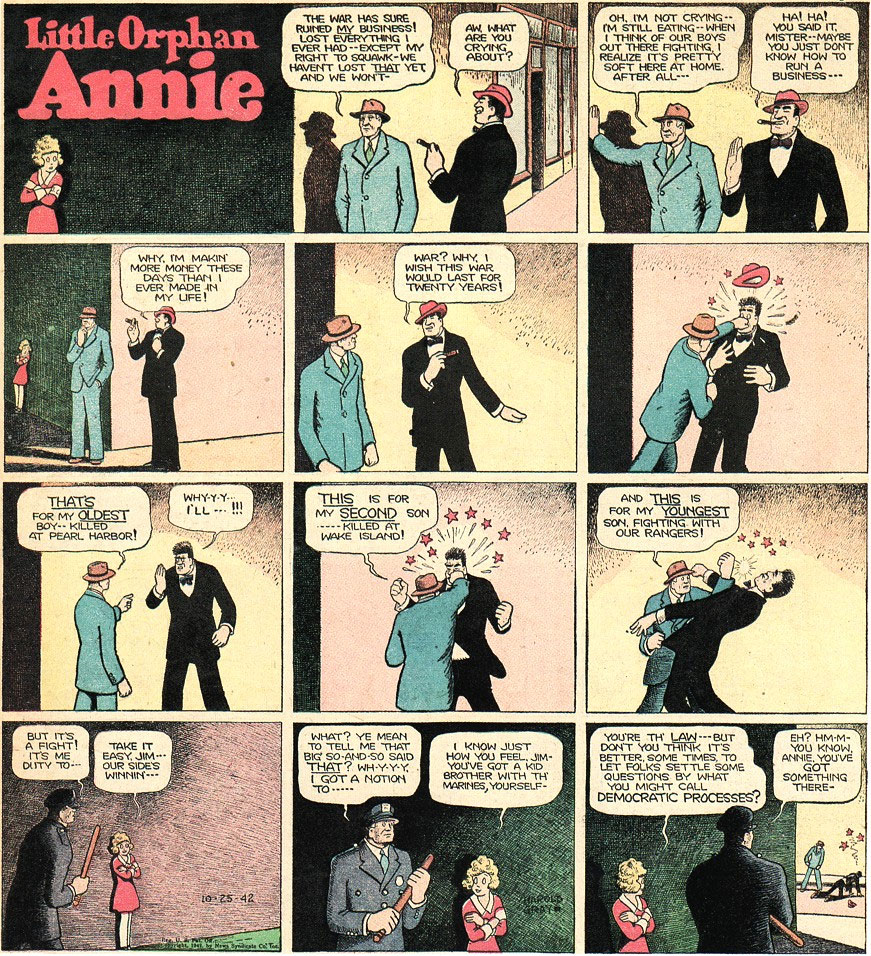
After 86 years of amazing adventure and right-wing preaching, the comic strip “Annie” (originally called “Little Orphan Annie”) ends today. Surprisingly, it’s not ending happily:
“Annie got kidnapped more than any child on the planet,” Maeder says.
And that, dear readers, is her predicament now.
She’s been spirited away to Guatemala by her war-criminal captor. Warbucks is huddling with the FBI and Interpol but there aren’t many clues.
Annie’s captor says they’re stuck with each other. Welcome to your new life, he says.
And there it ends.
You can read the final strip here.
At first, I felt irritated that Tribune Media (the owners of Annie) didn’t continue Annie long enough to let it end happily. But on rethinking, I kind of like it. We can take it on faith that Daddy Warbucks will eventually shake off his funk and rescue Annie, and that Annie and Warbucks together will defeat the kidnapper and go home for a while until the next dictator or mobster or union boss kidnaps Annie. It’s appropriate that the comic strip doesn’t really have an ending, because Annie’s adventures seemed endless.
Of course, I would have preferred that the comic strip end back in 1968, when creator Harold Gray died. Although Gray’s successors on the strip include some excellent cartoonists (Leonard Starr, for goodness sake!), none of them were able to bring Gray’s slightly frightening intensity and vitality to the strip.

(Click on the panel to read the entire strip.)
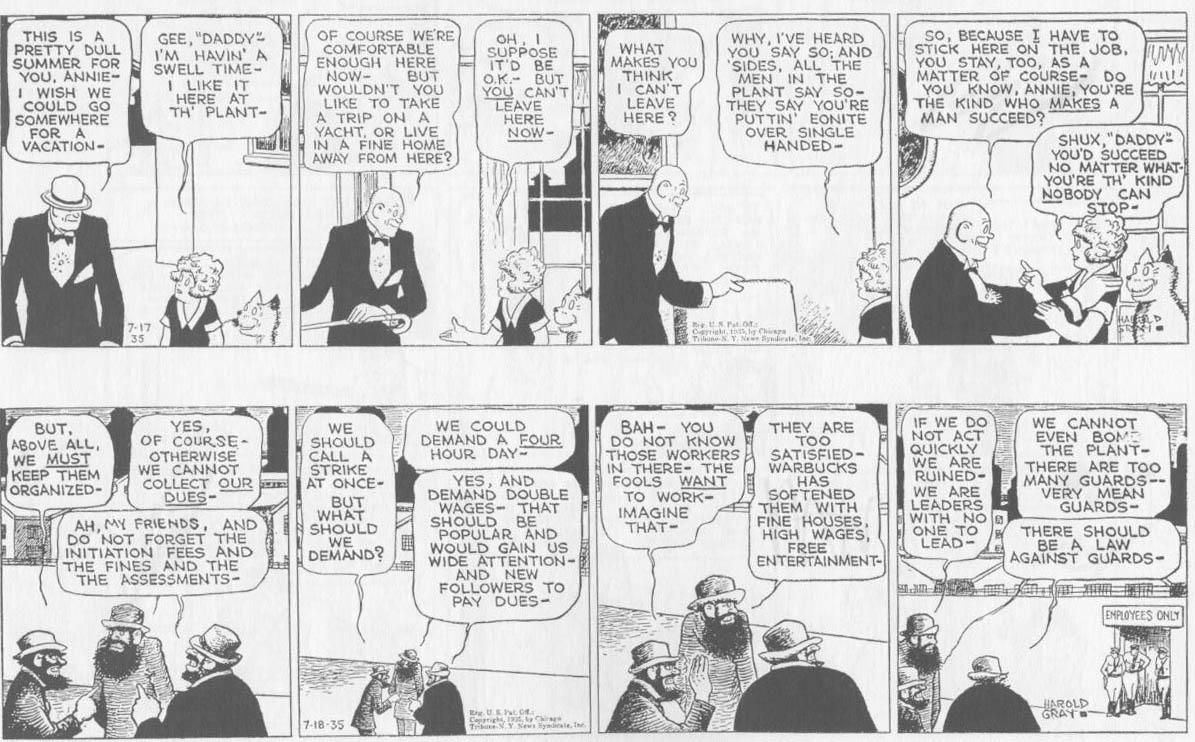
I like Gray’s artwork a lot. The tiny heads and enormous hands feel expressionistic. And I love how Gray’s artwork almost always seems claustrophobic; ceilings feel uncomfortably close to characters’ heads, even when Gray draws outdoor scenes. Gray’s drawing tells a story very efficiently, but where it really shines is in getting across Gray’s fictional world, a world which despite Annie’s relentless optimism, was frightening and difficult, and in which the new death threat or kidnapping was always just around the corner.
Gray’s claustrophobic artwork was also a good match for his political views, which were spectacularly narrow. Gray’s reaction to the great depression was to preach that anyone could make it if only they embraced hard work and optimism (and socked out the occasional thug); anyone talking about larger economic issues behind structural unemployment would have been dismissed by Gray as a whiner. (I really regret that Gray never showed Daddy Warbucks punching out Keynes.) Gray had an awesome ability to deny reality; but even though a world in which anyone can make it with a little pluck and some help from a redheaded orphan isn’t realistic, it is a fun fantasy to read in a comic strip.
I haven’t yet seen much blogging about the end of Annie (except for this post on Comicscomics). But here’s some interesting past blogging about Little Orphan Annie: Illustration Art has “Harold Gray: An Appreciation,” featuring several very large (if you click on them) reproductions of Gray’s artwork and the blog’s patented “you kids get off my lawn” attitude towards modern comics. Jeet Heer quotes some Art Spiegelman comments about Gray’s work, plus in the comments a reader is quite funny on the subject of what a lousy parent Daddy Warbucks was. And Madinkbeard, reviewing an old reprint collection, makes a number of very interesting comments about Little Orphan Annie.
On May 25, 2010 · Comments Off on Hereville mentioned by Publishers Weekly
 Hereville is mentioned in Douglas Wolk’s article on Publisher’s Weekly about BookExpo America. Hereville is mentioned in Douglas Wolk’s article on Publisher’s Weekly about BookExpo America.
On the kids’ side, Abrams will have previews of Barry Deutsch’s November graphic novel Hereville: How Mirka Got Her Sword, about an 11-year-old Orthodox Jewish troll fighter, and a signing by Diary of a Wimpy Kid’s Jeff Kinney thursday, 11 a.m.–noon.
Love the big image of the Hereville cover! Plus, almost certainly the first time I’ve ever been mentioned in the same sentence as Jeff Kinney. 😛
Hope Larson, an excellent graphic novelist (most recently Mercury) currently working on a comics adaptation of A Wrinkle In Time[*], recently conducted an informal survey of female comics readers who read comics in their tweens and teens. Click here to see Hope’s full report of the responses she got.
The part I found most fun to read was Hope’s summary of responses to her final, open-ended question:
What can authors, publishers, retailers do to better serve teen/tween girls?
1) More and better female characters, especially protagonists. Girls want to see strong, in-control, kick-ass women calling the shots.
2) A welcoming atmosphere in local comic stores is key. Many respondents reported feeling uncomfortable in comic stores. They were stared at, talked down to, and generally treated without respect.
3) Pink, sparkly cutesy comics about boyfriends, ponies, cupcakes and shopping are widely reviled. Condescend to female readers at your peril, writers and comic publishers.
4) The hypersexualization/objectification of female superheroines makes female readers uncomfortable, and sexual violence as a plot point has got to stop.
5) Girls need good stories in a variety of genres.
6) Most girls don’t even know comics exist, or that they would enjoy them. Publishers need to advertise in mainstream media and comic shops need to reach out to girls.
7) Make comics for boys and girls. Comics with dual male and female protagonists. Comics with large casts that offer something for everyone.
8) Use licensed properties to lure new readers into comics.
9) Availability is a problem. Get more comics into schools. Get more comics into libraries—especially school libraries. Get more comics into bookstores, especially large chains.
10) There need to be more women creating comics and working in the industry as editors and publishers.
What do you think?
[*] I hope Hope gets to adapt A Wind In The Door, too — it’s arguably a better book, and it has tons of amazing imagery that I think would fit beautifully into Hope’s style. But I’m not certain I want to see the borders-on-racist A Swiftly Tilting Planet adapted.

Click on the image to see a bigger version.
Barry: Oh wow. (Looks around, sees Jake.) Hey, Jake, look at this layout.
Jake: Oh? (Picks up book, looks at page.) Wow.

This is from “Space,” the fourth volume of Osamu Tezuka’s Phoenix series, originally published in 1969. The layout device, which on this page emphasizes the group coming together as a team but eventually emphasizes each character’s separateness, is continued for many pages of the book.
It’s hard to describe Pheonix, which I’ve so far read the first five volumes of. Each volume is a story that stands entirely on its own, set thousands of years apart from the other stories, some of which take place in prehistory, others in a science-fiction future — but through reincarnation, the same characters appear as different people in multiple volumes. The ambition and scope of some of these stories is jaw-dropping. If you’re going to read just one, I’d recommend Karma, which is the best one I’ve read so far (and, some people say, the best manga ever created).
(A lot of Pheonix would be rated “R” if it were a movie, due to occasional nudity and also some extreme violence at times, so if you’re a kid you should check with your parents before reading it.)
One of the comics I picked up at Stumptown was Lotus Root Children, by Wei Li.
(SPOILERS below!)
 Image from Lotus Root Children Li told me that he was inspired by the documentary “China’s Stolen Children.” As you might expect, the approximately 50 page comic tells a sad story, but Li tells it very well. The main character is a child trafficker. She doesn’t personally steal the children; she takes care of the children between when they are kidnapped and when buyers for the children are found. During this time, she mothers the children, with genuine affection, and also brainwashes them to forget their prior lives. The character was believable and — despite what we learn about her in the course of the comic — likable, although I wanted to know more about her and her background. How did her life reach this point?
Li’s artwork is nice; he uses very lively brushstrokes both for the linework and for the coloring, which I enjoyed. The underlying drawing isn’t always assured — the anatomy seems a bit shaky sometimes – but it’s good, and I’m sure it’ll get better as Li goes on. (His new project, The Old Woman, looks great — you can see preview artwork for it here). The layout approach is also a little inconsistent; early on, Li plays around a little with breaking up a three-tiers-per-page layout, while in the last half of the book he hardly ever strays from it, and I don’t see any story-based reason for the change in approach.
But I’m nit-picking. The art is very well-done and shows potential to get a lot better, and the writing is ambitious and interesting. Li is definitely someone who believes comics can be more than fight scenes, and I’ll be looking for more of Li’s comics at future cons.
I do have one actual complaint, which is that the paper version of Lotus Root Children is in gray tones that are rather muddy. Later on, I checked it out online — and discovered that the art was drawn in color, with rich blues popping the characters out of greenish graywash backgrounds. It looks twice as good with the colors. So while I’d hate to deprive Li of sales, I’d recommend reading Lotus Root Children online instead of buying the comic.
|
|