On April 1, 2010 · Comments Off on Tonight: The 6th Annual Stumptown Comics Fest Art Show
I’ll be at the 6th Annual Stumptown Comics Fest Art Show tonight. The exhibit is at the Portland Center for the Performing Arts (1111 SW Broadway). I’ll have two pages from the upcoming Hereville graphic novel on display!
If you’re in downtown Portland tonight, drop in and say hi. 🙂
This is an art exhibit associated with the Stumptown Comics Fest. The Fest itself, a two-day comic book convention, takes place in a few weeks, April 24th and 25th. I’ll be there, too; for more info about the Stumptown Comics Fest, visit their site.
Scott McCloud, bouncing off a post by Joe at Comics Comics, explains his preference for thought captions over thought balloons:
The question I find most interesting is why do traditional word balloons seem more patronizing by their very nature? […]
The important difference for me is that a thought caption—with or without borders—embodies each thought in a way that encourages us to assume ownership of it as we read. We literally bring each sentiment into existence as a thought, creating an instant bond with the character.
The thought balloon, regardless of shape or style, just by virtue of its pointer, brings a third party into the relationship: the author, gently putting his/her hand on our shoulder and pointing to the face of the thinker with the words “he thought.” Maybe thoughts are just too private for that kind of parental intrusion.
I don’t think Scott’s argument holds water, for four reasons:
1) Logically, shouldn’t Scott also find pointers on speech balloons condescending? If telling the reader who is thinking is spoon-feeding, telling the reader who is speaking must be as well. There’s no reason speech balloons can’t be dispensed with (see Why I Hate Saturn).
(Scott tries to handwave past this by saying maybe thoughts are too just too private, but that seems like a very hazy distinction.)
2) If someone did a comic with old-fashioned thought balloons, but without pointers (so only context told readers which character a thought balloon attached to), would that really resolve anyone’s dislike for the device?
3) No one thinks it’s condescending for a prose writer to specify which character thinks a thought (“Oh, drat, I’ve cut off my ear,” Vince thought.). So why is the visual equivalent of “Vince thought” unacceptable hand-holding?
4) Even if thought balloons “bring a third party into the relationship,” why is that a bad thing? Absolute authorial transparency is an aesthetic goal of some cartoonists (one that can be approached but never achieved), but it’s not better or worse than other aesthetic approaches.
Joe at Comics Comics, in contrast to Scott, argues that thought balloons are more intimate than thought captions:
…captions can be a likewise cool device, sharp-edged and—this is vital—aloof from the thinking character, hanging away from their head or drifting through entirely unrelated scenes, panels with no characters at all. In contrast, thought balloons have a ‘chain’ that latches them to the applicable thinker, a forced, perhaps confining intimacy, very revealing in looking so silly like fresh thoughts would seem if seen.
I agree with Joe, on this question. There’s a spectrum of integration of words (and their containers) into the comic’s images; the less integrated the words and images, the more aloof the words feel from the images (and the characters).
At one extreme, we have the cartoonists who keep words at arm’s length by placing the words entirely outside the panel — Why I Hate Saturn, Prince Valient.
In the middle is the standard rectangular caption box.
At the other extreme, words are seamlessly integrated into the picture and vice-versa.
In the hands of a good cartoonist, either captions or balloons work well. But I’d argue that the old-fashioned thought balloon has enormous advantages, because of its inherent integration into images. Check out this page from one of my favorite comics, Larry Marder’s Beanworld:

This is actually a very complex page. Beanish begins by thinking in words, switches to thinking in images, and then switches again to getting lost in memories that are a mix of words and image – memories from yesterday, as the non-Beanish narrative voice helpfully tells us. Then he switches again to spoken monologue interspersed with visual thoughts. That’s a hell of a lot to get across, but Larry’s expert use of thought balloons makes it all seem straightforward.
Could you do the same thing with captions? Maybe. But it wouldn’t be easy.
Here’s the amazing Kevin Huizenga, showing his character Glenn Ganges either traveling through time or just imagining traveling through time (click on the image to see it bigger):

I have two more examples of amazing uses of thought balloons — but they get into some mildly sexual images. If that offends you, or if you’re a minor and you think your parents would be offended if you saw some R-rated content, then pleased don’t click through to view these images.
First, check out this page by Howard Cruse, from his classic short story “Billy Goes Out,” which is available in this collection. Howard uses thought balloons brilliantly to show a parallel narrative; we see Billy’s day and we experience Billy’s thoughts with Billy. A separate narrative voice, not representing Billy’s thoughts, speaks to us through captions. (This page is mildly NSFW.)
Second, look at this page from Dave Sim’s Cerebus. I don’t think any cartoonist has done more experimenting with thought balloons than Sim; to look at one page barely scratches the surface. On this page, Sim uses thought balloons to not only show the back-and-forth between competing thought streams in Cerebus’ head, but also to show their relative volume, their relationship, their emotional content, and to suggest streams of simultaneous, overlapping thought. (This page is safe for work — there’s nothing there that couldn’t be in a PG movie — but Cerebus is kinda obsessed with boobs.)
So why are people so down on thought balloons? It’s not just Scott; as Joe at Comics Comics reports, some mainstream comic book editors are actively discouraging creators from using thought balloons at all.
For some folks (and here I’m definitely not talking about Scott or Joe), thought balloons seem too — well — comic book-y. The dislike of thought balloons is related to how insecure many comic book folks are about comics; we want comics to be acknowledged as a legitimate medium for art. (It’s amazing, and sad, how many comics fans and professionals believe movie adaptations legitimize comics.) Words in captions are closer to the way books do narrative, or perhaps closer to the way movies do voice-overs. Either way, comics seem more like these “legitimate” mediums if they avoid the use of tools that belong, uniquely, to comics.
Thought balloons are iconographic, which is why they can be used so wonderfully in the examples I’ve shared here. But they’re also cartoony, and that’s an approach many folks who want to make sophisticated, literary comics want to avoid.
The irony, of course, is that thought balloons — well used — can be an extremely sophisticated and subtle device. By arbitrarily cutting them out, editors may actually be making their comics less subtle and less sophisticated.
On March 22, 2010 · Comments Off on “Thundercats” and “Timespirits” Writer Needs Help
When I was a kid, the “Timespirits” comic book — which was published by Marvel (under the “Epic Comics” imprint) and only lasted nine issues — was very special to me. I read the too-few issues again and again, captivated by the rather trippy time-travel adventures and by Tom Yeates’ artwork.
Timespirits was probably the first comic book I read in which nearly all the important characters (including the ghost of Jimmi Hendrix, extremely well drawn by Tom Yeates), and both the protagonists, were people of color. That’s still damned rare nowadays, but it was virtually unknown in the 1980s.
I haven’t read Timespirits in years (it’s long out of print, alas, although apparently Image is working on a trade paperback reprint), and I don’t know how well they’d hold up. But I remember them fondly, so I was sad to find out that Steve Perry, the writer of Timespirits (and also a writer on the old “Thundercats” TV show), is having troubles he won’t recover from.
Ann Somerville reports:
I got a lovely thank you note from Steve Perry, but the contents break my heart:
I want you to know I am so very grateful to you for being so kind, generous and wonderful — my own fate is pretty iffy and I care most about my five year old. He has been with me 24/7 all his life, and even more so since his mother left a year ago because she could not deal with the discovery that I had cancer. Now that it has returned, the future is pretty raw, and while Leo and I face homelessness again, your kindness will be forever appreciated. Thank you so very, very much.
He also says he’s still trying to get his electricity back on. In case it wasn’t clear from my last post, Steve is dying of bladder cancer. And on top of that, he has no home and is trying to look after a young child. No one should have to go through all this in the last months of their life. So, again, I’m asking you to send a donation, however small, to his PayPal account (sandramaples48 @ yahoo.com). Some of you boosted the signal on this, and a lot of you went ‘eh, nothing to do with me’. Which is sad, really, because anyone can end up with cancer, and anyone could end up homeless too.
Well, if I can’t incentivise you any other way, I will give a free copy of any of my ebooks – self-published or not, including the one which I can’t officially give you – to anyone who sends me a receipt for their Paypal donation of at least $10 to Steve. Redact your real name, but I want to see proof. Forward it to me at logophilos@gmail.com and tell me the book you want.
Feel free to repost this message.
I’ll offer a similar deal: If you’re one of the first five people to email me a copy of their Paypal receipt, showing a donation of $40 or more to Steve Perry, I’ll mail you a hand-drawn sketch of the Hereville character of your choice — or even a Thundercat, if you prefer — on good-quality paper. (I’ll update this post once the offer is closed — so if you can read this, then the offer’s still open!).
Steve Bissette and Johnny Bacardi have both posted more about Steve Perry’s circumstances.
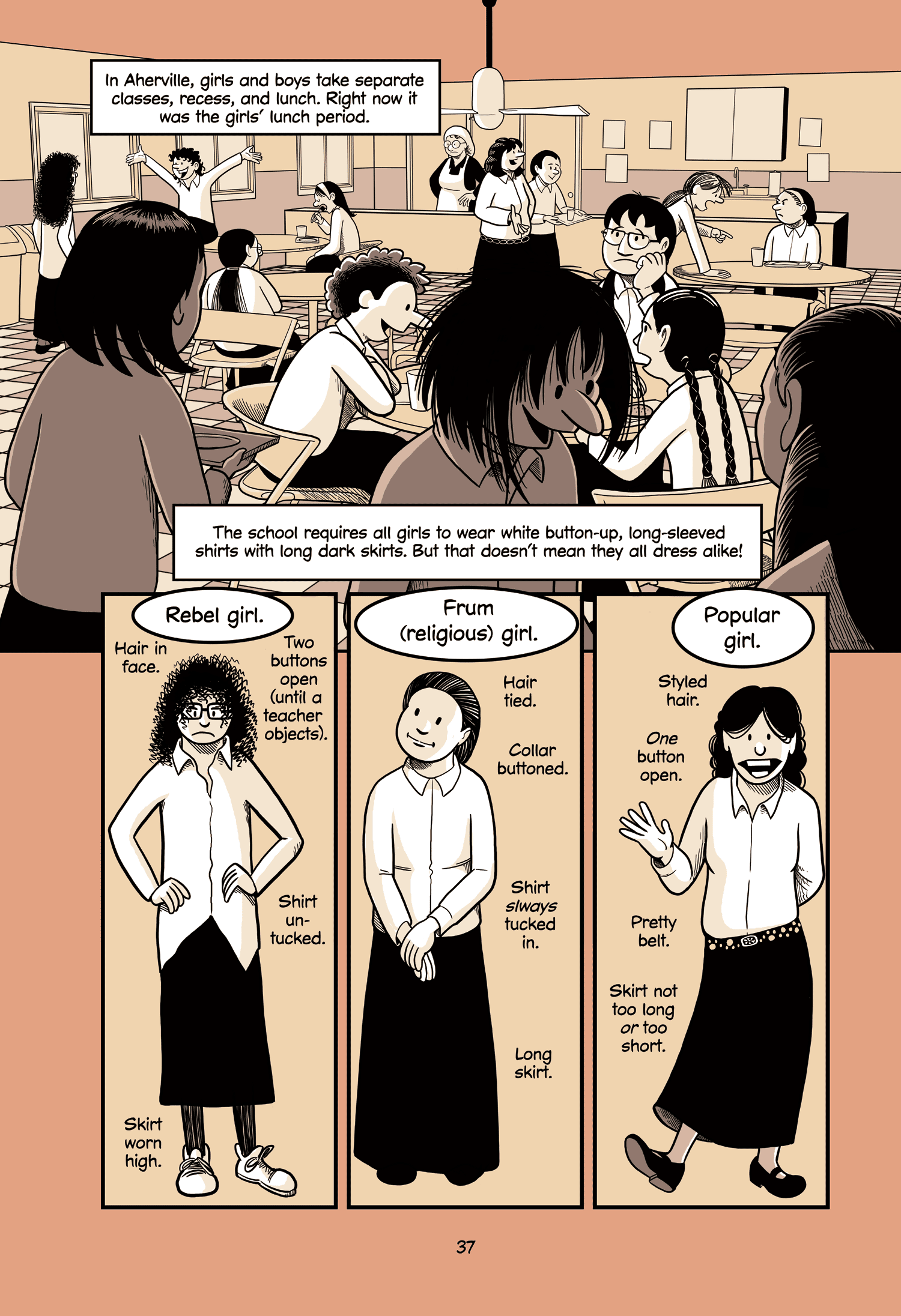
I already posted part of this page in progress, but I haven’t posted the whole page before, and now you get to see it with Jake’s colors. Enjoy!

(Click on the image for a bigger size).
I finished drawing the “Hereville” graphic novel this weekend, and Jake finished colors. That doesn’t mean I’m all done — there’s still a significant amount of work to do (title page, back cover art, fixes requested by the publisher, etc) — but still: YAY! I’m very happy to have gotten the principle art done, and I’m pretty pleased with the book as a whole.
Below: All 139 pages of the graphic novel, plus the front cover. It might be a tad hard to read at this size, though… A larger sized version will be in bookstores in November. 😛

On February 8, 2010 · Comments Off on Another Hereville preview image: Mirka’s whole family
All Mirka’s siblings, plus her father and her stepmother, and Mirka herself. This was fun to draw.

(Click on the image to see a bigger version).
On February 1, 2010 · Comments Off on A preview page — and Introducing Jake
Here’s a page of art from the upcoming graphic novel. The graphic novel will be 139 pages long, of which 100 are inked and I’m not sure exactly how many (but a lot) are colored. If all goes well, all 139 pages will be complete five weeks from now. And I will be exhausted.
Which brings me to something I should have mentioned; I now have a collaborator on Hereville. Mr. Jake Richmond, my friend and an excellent cartoonist and game designer, is coloring Hereville. Thanks, Jake!
Anyway, here’s a preview page:

Here, you can see my workspace. See, I’m drawing Hereville!
I have the great good luck to be drawing on a Cintiq, which is pretty much the greatest invention since… actually, it’s way better than sliced bread. On the right side of the picture, you can see a bit of my model sheets.

While working, I listen to dozens of podcasts. My favorites include This American Life, The Moth, Here & Now, Podcastle, and Don’t Quit Your Day Job.
Thanks to Chris O’Rourke for the photo!
Here’s a background I just drew, to a couple of panels on page 57 of the graphic novel.
The Hereville graphic novel will be released in November, but until then I’ll be occasionally posting preview images. Thanks for your patience!

I haven’t forgotten Hereville! I’m still working hard on the graphic novel.
Right now, I don’t have time to do much of anything but draw Hereville, which is one reason I’ve been posting so rarely. I should finish drawing the graphic novel in March, and after I’ll be a bit more active with posting.
Here’s a panel I just inked, showing Mirka’s school’s cafeteria. You can see Mirka and her sisters Gittel and Rochel, sitting at the table closest to the viewer (behind the girl with the spikey hair). Gittel is the one with glasses.

Click on the panel to see it bigger.